What Is IPA and How to Read Pronunciation Symbols
A practical guide to IPA: how to spot stress, schwa, vowel length, and key sound contrasts in dictionary transcription without getting lost.
You open a dictionary, see something like /ˈneɪʃən/, /ˈlæŋɡwɪdʒ/, or /prəˌnʌnsiˈeɪʃən/, and the page suddenly feels less friendly. For many language learners, that is what a first encounter with phonetic transcription feels like. It looks technical, but IPA exists for one very practical reason: to show how a word actually sounds, not how its spelling suggests it should sound.
English is where many learners feel the need for IPA first, because spelling is often unreliable. But the same system helps in any language when you need to see stress, a precise vowel, or a pronunciation contrast that ordinary spelling hides. Each symbol is tied to a sound, not just to a spelling pattern.
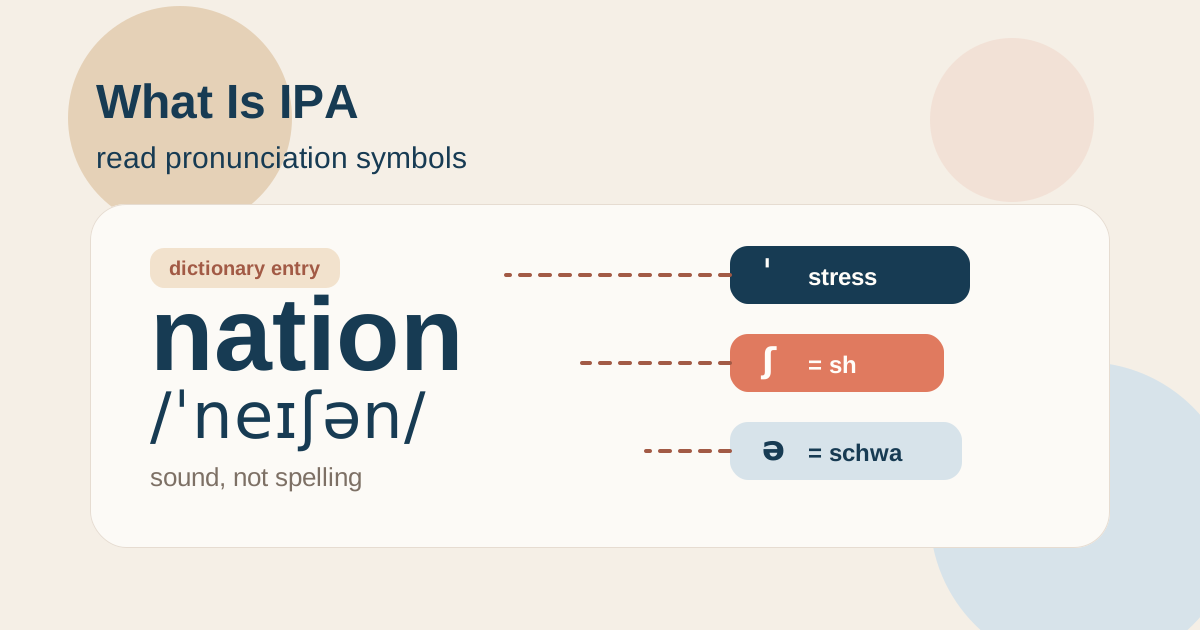
IPA transcription of nation with its pronunciation symbols explained
In this article, we'll break down what IPA is, how to read a basic dictionary transcription without panic, which marks matter first, and how to turn those symbols into real pronunciation. Because this version is written in English, I'll use familiar English examples first and then point out how the same logic carries over to other languages.
What IPA Actually Is
IPA, or the International Phonetic Alphabet, is a standard system for writing the sounds of human language. Not letters. Sounds.
The basic idea is simple:
ordinary spelling shows how a word is conventionally written;
IPA shows how the word is pronounced;
the same IPA symbol refers to the same kind of sound across words.
That is why IPA appears in dictionaries, pronunciation guides, phonetics textbooks, and language-learning tools. If you want to see the whole system, the International Phonetic Association has an official interactive IPA chart where you can explore the symbols and hear examples.
The important part is this: you do not need to learn the entire IPA chart to start using it well. For most learners, it is enough to recognize a few important marks and a few recurring symbols in the language they are actually studying.
How to Read Transcription in a Dictionary
Most learners are not really overwhelmed by the symbols themselves. They are overwhelmed because they do not know which parts of the transcription matter first. In practice, most dictionary entries contain just a few high-value signals.
Slashes / /
When you see a transcription like /.../, that usually means a phonemic transcription. It shows the main sounds without too much fine detail.
Sometimes you will also see square brackets [ ]. These are more common in narrower phonetic writing. In everyday language learning, the slash version is usually enough.
Below, I mostly use slashes because that is what many English learner dictionaries show. But the main idea stays the same either way: IPA tells you how the word sounds, not simply how it is spelled.
Stress ˈ and ˌ
One of the most useful symbols in a transcription is not a sound at all.
ˈmeans primary stressˌmeans secondary stress
For example:
about-/əˈbaʊt/pronunciation-/prəˌnʌnsiˈeɪʃən/
In both cases, the mark appears before the stressed syllable. That is why even a quick glance at the transcription can tell you where the word is centered rhythmically.
If you ignore stress, you can know all the individual sounds in a word and still sound unnatural. In many languages, stress is one of the highest-value details in the whole entry.
Length ː
The raised colon, as in /iː/ or /ɔː/, marks a longer vowel. It does not always mean "hold exactly the same sound longer," but it does warn you that this is not the same vowel as the short version.
For example:
sheep-/ʃiːp/ship-/ʃɪp/
The difference here is not just length. It is also vowel quality. IPA is helpful precisely because it forces you to notice that these are not the same vowel.
Schwa ə
The symbol ə, called schwa, shows up constantly in English. It is a short, unstressed, neutral vowel, and it is one of the main reasons English pronunciation often sounds less literal than spelling suggests.
For example:
about-/əˈbaʊt/banana-/bəˈnænə/
Once you start noticing schwa, a lot of everyday English pronunciation becomes easier to hear and imitate.
One Entry, Decoded
Take a simple dictionary entry like this:
nation-/ˈneɪʃən/
That short line already carries a lot of useful information:
the slashes tell you this is transcription;
ˈtells you the stress falls on the first syllable;eɪshows the vowel in the stressed part of the word;ʃtells you the spellingtidoes not sound like a literalt;əshows that the ending is reduced.
That is the real value of transcription: it helps you see the sound structure of the word instead of trusting spelling and guessing.
Which Symbols and Marks Matter First
One of the most common mistakes is to open the full IPA chart and try to memorize everything at once, including rare diacritics and symbols for languages you are not even studying. That is a reliable way to overload yourself.
It is much more effective to start with the marks and contrasts that change your pronunciation and listening the fastest.
Quick Cheat Sheet
If you want a short high-value list, start here:
/ /- signals that you are looking at a transcriptionˈ- primary stress; one of the most useful marks in the systemˌ- secondary stress in longer wordsː- length or a separate vowel contrast in some languagesə- a weak vowel that matters constantly in Englishθandð- as inthinkandthisɪandiː- as inshipandsheepŋ- as insingtʃanddʒ- affricates like the sounds inchandj
In Familiar English Words
If you want to practice on material that already feels familiar, these are good places to start:
think-/θɪŋk/this-/ðɪs/ship-/ʃɪp/sheep-/ʃiːp/sing-/sɪŋ/nation-/ˈneɪʃən/
These examples already show some of the most useful things IPA can tell you:
which consonant contrast is really there;
whether two vowels are actually different;
where stress lands;
where spelling stops being a trustworthy guide.
If Your Target Language Is Not English
The same approach works outside English too. In another language, the high-value details may be different:
stress placement;
vowel length;
softened consonants;
affricates or sound combinations;
contrasts that spelling hides or flattens.
So the point is not "learn English IPA first." The point is to learn the part of IPA that makes your current target language easier to hear and pronounce.
If Dictionaries Differ Slightly
Once you compare different dictionaries, you will notice that the transcriptions are not always identical. That is normal.
For example, British dictionaries often show go as /ɡəʊ/, while American dictionaries often show /ɡoʊ/. That does not mean one of them is wrong. It means they are representing different accent norms.
You see the same thing with words like car: a non-rhotic British transcription is often /kɑː/, while an American one is often /kɑr/.
The useful question is not "Why is this not written exactly the same way as in another dictionary?" The useful question is "What sound or accent difference is this entry trying to show me?"
How to Actually Learn to Read IPA
IPA becomes useful when you connect it to audio and to your own speech, not when you memorize symbol names in isolation.
1. Start With Words You Think You Already Know
Take 20 to 30 words you feel familiar with. Then check the transcription and see how much detail you were skipping:
where the stress really falls;
whether the vowel is the one you expected;
whether there is a schwa or another weak syllable;
whether your pronunciation actually matches the dictionary.
That gap between "I thought I knew this word" and "this is what the transcription says" is where IPA becomes practical.
2. Learn Contrasts, Not Random Symbols
It is better to learn one contrast like /ɪ/ versus /iː/ than to memorize ten isolated symbols with no context. IPA sticks much better when it comes through comparison.
3. Always Tie the Symbol to a Sound
A symbol without audio turns into an abstract mark very fast. A symbol plus an audio example plus your own spoken attempt turns into a working tool.
That is why a useful cycle looks like this:
read the transcription;
listen to the word;
repeat it out loud;
return to the transcription and check what you were trying to reproduce.
4. Do Not Treat IPA as an Alternative Spelling System
The point is not to rewrite every word in IPA in your notebook. The point is to use transcription as a fast, precise sound cue when spelling is not enough.
5. Accept Small Differences Between Sources
IPA is standardized, but dictionaries still choose different accent targets, different levels of detail, and sometimes slightly different editorial conventions. That is fine. Your goal is not to find a single sacred transcription. Your goal is to understand what the transcription is pointing you toward.
Common Mistakes When Working With Transcription
There are a few traps that even careful learners fall into.
Ignoring Stress
Many learners look only at the sound symbols and skip ˈ. In real pronunciation, though, stress is often one of the first things that makes speech sound natural or unnatural.
Hunting Only for the "Weird" Symbols
Learners often fixate on θ, ð, or ʒ, but miss the more ordinary and equally important details: stress, vowel contrasts, weak syllables, and length.
Trying to Learn the Whole System Up Front
IPA works best in stages. Start with familiar words and with the symbols that keep appearing in the language you are actively studying. You do not need the entire chart on day one.
How Polidict Helps Turn IPA Into Real Pronunciation
Transcription is useful on its own, but progress becomes much faster when it is tied to regular practice. That is where IPA stops being a decorative dictionary extra and starts becoming part of real learning.
In Polidict, that matters because we do not treat a word as just one abstract object. We treat it as a bundle of separate skills:
hear the word;
recognize it;
understand the meaning;
reproduce the pronunciation;
write it independently.
That is why transcription is most useful when it sits next to audio, listening, and speaking practice. When you see IPA, hear the word, and immediately try to say it yourself, the symbols start to stick naturally. Not as a separate theory lesson, but as part of your repeated contact with real words.
If that approach matches how you want to learn, you can also read our article on vocabulary mastery, where we explain in more detail how audio, context, active recall, and different training formats support each other.
Conclusion
You do not need to be afraid of IPA. It is not a code for specialists. It is a compact layer of pronunciation guidance for learners who want to hear words more accurately and say them more naturally.
The most important things to take away at the start are:
IPA shows how a word sounds, not how it is spelled.
For practical work, it is enough to notice stress, vowel length, weak vowels, and a few key contrasts in the language you are studying.
Symbols become easier to remember when you connect them to audio and to your own pronunciation.
If you want to get immediate value from this article, try this today:
Pick 10 words from the language you are currently studying.
Check their transcription in a dictionary.
Mark where you guessed the stress, vowel, or weak syllable incorrectly.
Listen to the audio and say the words out loud again with the IPA in mind.
After one short cycle like that, IPA stops feeling abstract and starts working like a real cue. If you want to practice that systematically alongside audio, listening, and speaking, try Polidict. Once those pieces start working together, transcription becomes much more natural very quickly.